Honor the Harvest

The National Dairy Council has a Health & Wellness Advisory Council and American Academy of Family Physicians is a member of the council. I have been serving as the AAFP liaison to the council for a couple years and have learned a lot about nutrition science and agriculture as a result.

This video was from the Honor the Harvest Thought Leader Summer in Rosemont, IL. For more information about the Honor the Harvest plan for food sustainability check out the infographic here.

NDC Honor the Harvest Thought Leader Summit from Margot Savoy on Vimeo.
Life is like a Toilet?

My first lesson of 2015 is that apparently toilets can be a metaphor (well, technically a simile since I used like or as… sorry Mom!) for life.

The toilet that took down my house. I think it is smiling at me...
The toilet that took down my house. I think it is smiling at me…

No. Not that life is something to crap on… Sheesh. Why so negative people?! I simply mean that the experience of dealing with a broken toilet reminded me of some important life lessons.

The back story is simple. I went to work. I came home and there was a river flowing from my front door. Turns out the master toilet had overflowed and the backup shut off mechanisms didn’t cut off the flow of water so it ran… probably for the whole 6 hours I was away.

Confusion, panic, disbelief then angst followed in rapid succession.

Now a few days removed as I patiently sit on my living room couch watching several really nice guys deconstruct my house I have some perspective. Or I have to find something productive to do to distract me from the anxiety I am feeling. Go with the explanation that makes you feel happiest.

You don’t really appreciate toilets until they stop working. And when they stop working it can be abrupt… painfully abrupt.
I think the same thing can be said for lots of things- like car batteries, hot water heaters and committee members. Yes, I said committee members. Ever notice that the ones doing the yeoman’s work on the committee are usually too busy to be the loud obnoxious one? When he leaves the committee everyone is sad but fairly unmoved until things that used to get done just stop happening.

If one keeps running uncontrolled it will eventually overflow and mess up everything around it. And sometimes the mechanisms to prevent the overflow will fail. Yup. You need more than just a plan B people.
The Swiss Cheese model doesn’t just apply to patient safety in hospitals. It took both the toilet to fail to drain correctly AND the shut off to fail to trigger to create the internal waterfall in my house. And the reality is you can’t plan for everything. It is worth considering if you are the toilet. Are you constantly running without a break? Have you done the preventive measures to make sure you are not spewing frustration, fatigue or last minute tasks on others at the worst possible moment? It’s easy to run yourself ragged trying to be all things to all people only to let someone down at a critical moment because you can’t keep pace.

My foyer used to have a ceiling and a floor

You can call the plumber. He can be smartest and have graduated from the Ivy League of plumber schools. Toilets (like patients) don’t read the book about how to break. So sometimes there is no simple solution or straightforward answer. Deal with it. Sometimes stuff happens and mechanical things break.
There just isn’t always an easy solution in life. Just like with medicine. You can have the flu. We know it’s the flu and yet we won’t know what your “course” will be until you live it. Sure there are patterns and predictions, but the reality is that ultimately each situation is unique.

Having insurance won’t cover all your needs. And you will have to pay the deductible but hopefully it will make the total costs manageable.
What looked on the surface to be a scratch turned out to be a gaping festering wound once the contractors started drying my house out. Yes, the deductible is a chunk of change. And yes the annual premiums could have paid for several vacations over the years, but this one unforeseen incident would put a serious dent in my savings account. Same holds true for medicine. While I understand that health insurance can be costly, your body is worth more than a house! We can’t predict when the motor vehicle accident, stroke or cancer will appear and take you out of commission. And the costs to fix you will make my home repair bill pale in comparison.

2015-01-09 11.37.08
“My floor” was actually 5 different floors! Who knew?

You have to know how to cut problems off at the source so they don’t keep flooding everything.
Thankfully my parents have been adamant about teaching life skills—like knowing how to shut down the toilet or the main water line to the house. Same holds true for life’s problems. If you have a situation that keeps resurfacing don’t just try to clean the surface. I could have patted the ceiling dry and repainted it but that would have left me with festering issues. I needed to get down to the studs and subfloors to make sure everything dried sufficiently before rebuilding.

If you get caught standing in the pool of water lamenting the loss of money and time you could die from electrocution. Focus on the whole situation and not just the most obvious thing!
Just like there may be 2-3 (or 4…) layers of flooring under there and the leak may not be the toilet it could be the pipe in the wall, the depth of your problem may not be obvious at first. You can get seriously hurt if you are not paying attention and get caught standing in the pool water with the live wire floundering around. Are you so busy worrying about something superficial that you are ignoring a more important issue?

In the end, I want to be upset. I don’t like change. I don’t like strangers in my house, and I don’t like uncontrolled chaos (which I what my home life feels like right now). But there is a lot of good that will come from this. All the moving stuff around is forcing me to tackle organizing and pushing my decluttering goal to the front burner. My procrastination about making some minor home repairs—painting, flooring is no longer an option. I have to face the endless shades of yellow and pick a color for both above and below the chair rail! In a few months I may even look back and laugh. But for today, I’ll settle with finding a calm space amidst the demolition to start planning for the future.

‪#‎WaterFlowsDown | #Water>drywall | ‪#‎GuessImRenovating

Hidden Curriculum in Cultural Competency

Recognizing the Hidden Curriculum in Cultural Competency

Margot Savoy, MD, MPH, FAAFP, FABC, CPE (Originally published in the October, 2014 issue of DelFamDoc)

Recently I was asked if I first consider myself Black or female. My response was “neither.” It’s not that I don’t consider myself a Black woman, but I tend to think of myself first as a physician and then everything else. The question itself struck me as strange. Why would anyone be confined to being only one “thing?” I began to wonder how often we are trying to squeeze our patients (or colleagues) into convenient classification boxes? If the answer is more that we care to admit, how can we ever truly have a patient-centered, culturally competent interaction with one another?

The Hidden Curriculum

The hidden curriculum refers to the “set of influences that function at the level of the organizational structure and culture including, for example, implicit rules to survive the institution such as customs, rituals ad taken for granted aspects.“ The danger of the hidden curriculum is that it is not subject to review because everyone involved from the learners to the faculty take for granted the values and lessons it imparts. Often this subtle unspoken set of expectations and behaviors is a powerful unrecognized driver of the culture. While often discussed in medical education in relation to professionalism, the hidden curriculum can have a profound impact on other areas of medicine like cultural competency.

Cultural Competency: From Crosse to CLAS

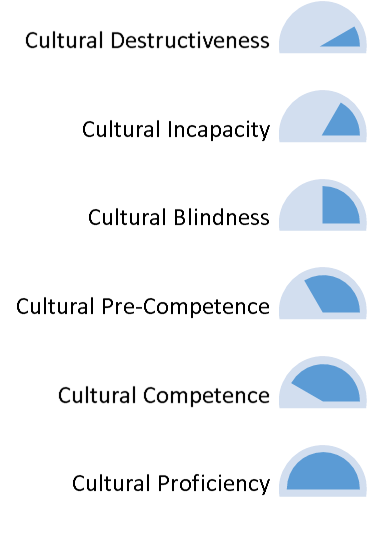
crossspectrum1A culturally competent system of care acknowledges and incorporates- at all levels–the importance of culture, the assessment of cross-cultural relations, vigilance towards the dynamics that result from cultural differences, the expansion of cultural knowledge, and the adaptation of services to meet culturally-unique needs.”1 The monograph describes a system (and an individual within a system) as striving to attain proficiency through an on-going developmental process that encourages the system to “ 1) value diversity; 2) have the capacity for cultural self-assessment; 3) be conscious of the dynamics inherent when cultures interact; 4) have institutionalized cultural knowledge; and 5) have developed adaptations to diversity.1 Figure 1 shows an adaptation of the continuum described in the monograph of how a system responds to cultural differences.1

In 2001, the United States Department of Health and Human Services Office of Minority Health released the National Standards for Culturally and Linguistically Appropriate Services in Health Care (CLAS standards). This collective set of mandates, guidelines, and recommendations was intended to inform, guide, and facilitate required and recommended practices related to culturally and linguistically appropriate health services. While initially slow to be adopted, the CLAS standards are now integral to routinely used quality metrics such as Patient-Centered Medical Home certification and Meaningful Use attestation.

Sipping Water From a Fire Hose

Cultural competency is a vast topic to cover in a short period of time. Asking a learner to “sip water from a fire hose” requires him to reorganize and simplify the information so that it can be effectively applied in real situations. Heuristics are problem solving strategies using readily accessible, though often loosely applicable, information to simplify the problem. Also known as “rules of thumb” or stereotyping, it allows a person to take a seemingly impossible set of options and whittle it down to a manageable few.

When my scout leader prepared us to camp overnight in the woods, she could not teach us every type of leaf we might encounter, but there were some she clearly needed us to avoid. Instead of trying to teach them all, she simply warned “leaves of 3, let it be” meaning poison ivy and oak tended to have leaves in threes so don’t touch them. While I’m sure there are other leaves best left untouched and some leaves in threes which were safe, overall it was a reasonable strategy (to this day I have never had poison ivy/oak dermatitis). However, when we apply these same types of heuristics to something more complicated like cultural competency problems are bound to ensue.

Challenging our Assumptions about Cultural Competency

The medical community recognizes the importance of being culturally sensitive and competent; however, simply drafting standards and check-lists is unlikely to change behavior if the hidden curriculum remains unexamined. Often the hidden curriculum becomes evident in the heuristics and language we use on a daily basis.

  • Do you automatically schedule every patient named Gonzalez a Spanish-speaking interpreter?
  • Do you check off the African-American box for every Black patient without asking?
  • Does your medical record have a way to record a gender other than male or female?

Having interpreters available is fantastic, and if your staff assumes every Gonzalez speaks Spanish you may be right some of the time—but when you are wrong, how will that patient feel? Similarly if you automatically check off the African-American box for every dark-skinned patient without asking first about her heritage, you will mislabel many patients including the many fair-skinned patients who are African-American but don’t fit your “rule of thumb.” And it isn’t just about race/ethnicity/language— a transgender patient doesn’t want to feel awkward every time she presents to your office because your EMR says she is male but she appears female and there is no place to choose transgender on your registration form. Assuming race/ethnicity, excluding gender options and guessing language preferences are all subtle but real manifestations demonstrating that you still have a long journey on the path to cultural competency.

Intellectual Curiosity is the Key

Cultural competency is an aspirational goal. It is more than simply learning how to avoid major social blunders. It is grooming ourselves to be genuinely open and receptive to alternate points of view. We cannot reasonably expect a couple of hours of medical humanities to transform a one-dimensional sheltered person into a well-rounded culturally competent physician. The only way to open our eyes to the infinite perspectives our patients bring to each encounter is to develop our intellectual curiosity through engaging life and educational experiences. Learning to ask questions rather than make assumptions. Recognizing that that if you know one “fill in the blank” patient you only know one “fill in the blank” patient. From my point of view once you are humble enough to know you can never know what it is truly like to walk in anyone else’s shoes, your journey to cultural competency has begun. ◊

References

  1. T L Cross ; B J Bazron ; K W Dennis ; M R Isaacs. “Towards a Culturally Competent System of Care: A Monograph on Effective Services for Minority Children Who Are Severely Emotionally Disturbed.” National Institute of Mental Health. 1989.
  2. Mary Catherine Beach, Eboni G. Price, Tiffany L. Gary, Karen A. Robinson, Aysegul Gozu, Ana Palacio, Carole Smarth, Mollie W. Jenckes, Carolyn Feuerstein, Eric B. Bass, Neil R. Powe, Lisa A. Cooper. Cultural Competency: A Systematic Review of Health Care Provider Educational Interventions. Med Care. 2005 April; 43(4): 356–373.
  3. Murray-García JL, García JA. The institutional context of multicultural education: what is your institutional curriculum? Acad Med. 2008 Jul;83(7):646-52.
  4. National Standards for Culturally and Linguistically Appropriate Services in Health Care Final Report, OMH, 2001. https://www.thinkculturalhealth.hhs.gov/includes/downloadpdf.asp?pdf=EnhancedNationalCLASStandards.pdf.(Last accessed 8-11-2014)

AAFP COD Series: Fearless Leadership

2014-10-22 09.17.30
All the campaigns launched today for next year’s election

Today wrapped up the 2014 Congress of Delegates for the AAFP. During the COD the Academy elects its national leaders: Board of Directors, Speaker and Vice Speaker and the President Elect. To get one of these positions is no easy task, and the price of admission is steep. Years of tireless effort to the AAFP both at the state and national level, building meaningful relationships across state lines and developing a vision for the future of the specialty.  Candidates must put themselves out in the political world to be evaluated, scrutinized and yes, judged, by fellow family physician leaders. And I would be remiss to mention that it isn’t simply your CV that is dissected and considered- each candidate must also give a speech to a few hundred wondering minds and then skillfully respond to the thought provoking (and at times controversial) questions presented from the floor. To say getting elected in our Academy is a gauntlet is probably being gentle. And yet year after year I watch in amazement at the talented souls who joyfully throw their hat into the ring. Experiencing their process as an observer I’ve felt such a wide range of emotions- nervous, excited, afraid, happiness, sadness, disappointment and perhaps most importantly pride.

As I reflect on the process I am struck that win or lose the leadership journey is truly an expensive one, and yet it is a price our leaders willingly pay.

For those leaders whose bid ended today in defeat, the price was paid but absent the momentary glory of the win. They invested time, money, and personal vulnerability and despite giving all they had to offer, they simply came up short. There will be no walk to the stage or swearing in ceremony for them. It can’t be easy to stand up from the floor and speak to the Congress with grace and dignity while the rawness of disappointment is still fresh. And yet one by one they congratulated their fellow family physician friends as they thanked their supporters and vowed to continue serving our Academy in other ways. Wow. Brave, fearless leadership is hard.

And then as I listened to the transitioning leadership who once stood at the same cusp as today’s newly elected leaders once did, joyful sacrifice appeared to be a universal sentiment. I was again struck by the costs—the nights travelling away from home, the countless meetings and appointments, decisions and discussions. Missed time with family, friends and patients that cannot truly ever be made up or reclaimed. But one by one each was clear- if they had it to do all over again, they would take up the torch all over again because it irrevocably changed their lives for the better.

2014-10-21 11.40.03
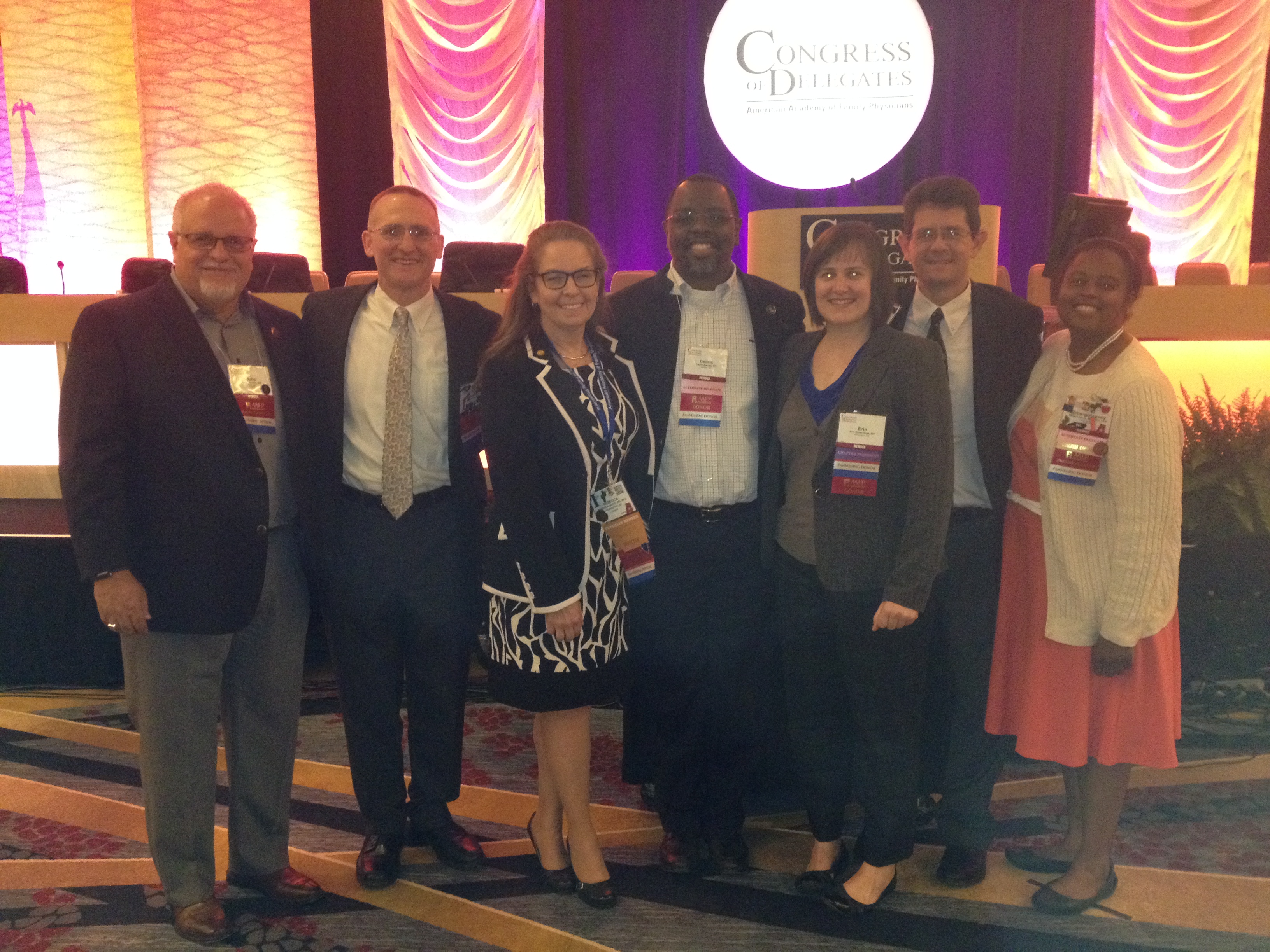
Our 2014 Delaware Delegation

I’m grateful that my Academy values my voice. I am honored that I get the opportunity to be in the room knowing that someday I’ll be able to say- I was there when #healthisprimary was launched or yes, I was there when they “unleashed the Bob.” I am inspired meeting the past presidents who turn out to be real people and not just formal headshots on the boardroom wall in Leawood. And I am tickled when they tell me their leadership stories and point out that they used to be right where I am now. Maybe, with some time, experience, and polishing, I’ll get the chance to tell someone the exact same thing!

AAFP COD Series: Respectful Disagreement

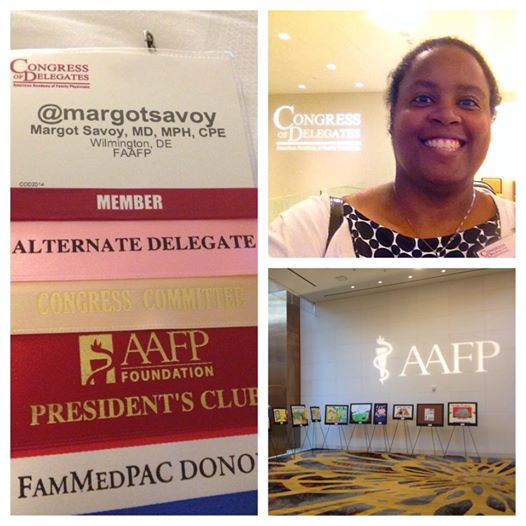
Like I mentioned earlier today I’m at the AAFP Congress of Delegates in Washington, DC this week as the alternate delegate from Delaware. With the first official day having come to a close, I have some time to reflect on the day’s festivities.

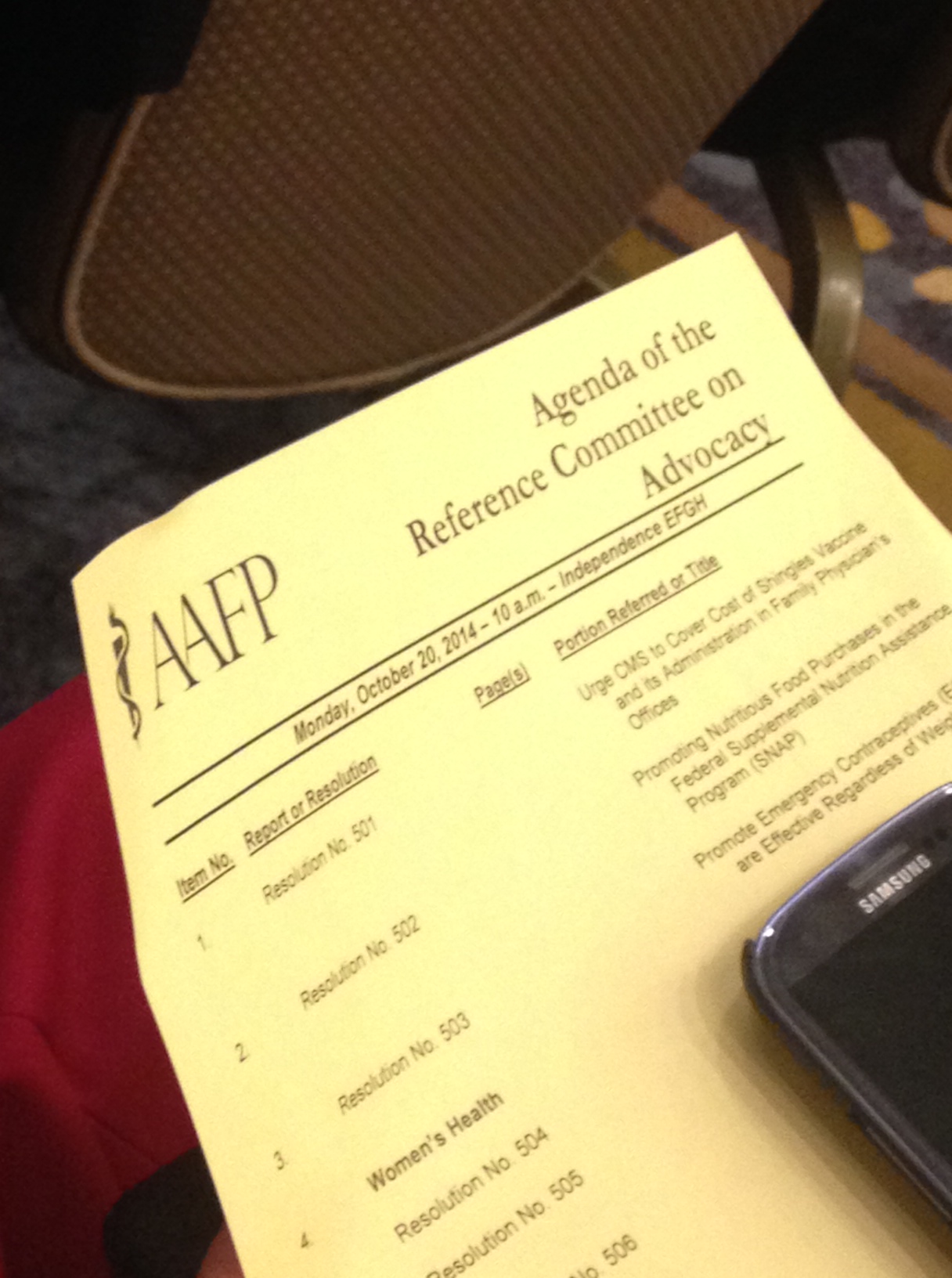
photoAt the AAFP COD, resolutions are referred to reference committees. These committees hear testimony from members on the various resolutions and then taking into account their expertise and the testimony shared, they draft recommendations for the Congress to consider over the next two days in session. So all day today was spent testifying about (and listening to other folks testify about) around 50 resolutions across the various reference committee hearings: Advocacy, Education, Health of the Public & Science, Practice Enhancement, and Organization & Finance.

Every COD I’ve attended there have been surprises- a combination of unexpected non-issues and presumed non-issues that actually sparked discussion, and this year was no different. Some testimony I found interesting today:

  • While there was relatively little discussion about promoting emergency contraceptive options with particular attention to the differing efficacies depending on the woman’s weight, a discussion about access to abortion services quickly appeared to draw a line in the sand among members. On one side urging the Academy to take a strong stand for supporting access to abortion services and urging members to consider abortion as a procedure no different than other medical procedures. While the other side remained adamant that if life begins at conception, murder is not simply a procedure like any other medical procedure. Currently the AAFP takes a neutral stance on abortion issues which is tolerable to the “pro-life” side and until recently was acceptable to the “pro-choice” side. But it was not lost on me that some of our members may be growing weary of the neutrality calling for a strong position- in opposite directions.
  • In another reference committee discussion about barriers to sterilization in Medicaid patients took on an interesting tone. Currently Medicaid patients wishing tubal ligation are required to have a 30 day waiting period before the procedure will be covered. This is not true for commercial or self-pay women requesting the procedure. Initially put in place to prevent physicians from forcing sterilization on vulnerable women of low socioeconomic status, now members are questioning why some women are considered vulnerable to being influenced post-partum while others retain unrestricted freedom of choice. A seemingly slam dunk of a resolution to me, it actually sparked some discussion. Some wondered whether all women should be required to wait 30 days. Others felt like no women should have to wait. Some expressed concerns that poor women may be subjected to undesired sterilization while others contended that creating a barrier to the woman isn’t the solution for potentially unprofessional physicians. [I found some interesting articles: perspective piece and ethics piece for anyone wishing to consider further.]
  • I expected there to be significant opposition to the resolution calling for more restrictions on personal belief vaccine exemptions. I thought there would be a vocal group concerned that we were removing your right to refuse vaccinations. To my (pleasant) surprise, there was little opposition. Seeing the growing number outbreaks of vaccine preventable due to unvaccinated kids/adults as a serious threat to public health appears to be outweighing the potential restrictions to personal freedom of choice. [To read more about the risks of personal belief exemption policies visit here.]
  • And the shocker of the day for me (mostly because I honestly didn’t see it coming) was a fairly loud dissenting voice to a policy to prohibit sale of unpasteurized milk and milk products. From my perspective this one was a no brainer. Why take the risk of infectious diseases when a perfectly suitable pasteurization process exists? Pasteurization was listed as one of the CDC’s top ten achievements in public health (safer healthier food supply). Yet the vocal opposition cited undue burden on farmers/families and personal preference for the benefits of raw milk as strong reasons to avoid adopting the resolution. I must admit I didn’t expect there to be 153,000 Google hits on the “benefits of unpasteurized milk” but alas they exist. Go figure.

There were plenty of other discussions and testimonies today that were interesting new perspectives I had not considered or reaffirmations of my own personal beliefs. What I think is the most impressive reflection on the whole day is that for as wide and deep as our Academy of ~116,000 members may be, all of these discussions- both formal and informal, were respectful disagreements. There was no name calling, finger wagging, slandering or personal attacks. Instead there were simply statements for or against the wide range of resolutions with varying levels of emotion and evidence supporting the provided testimony. So for now we all wait with baited breath to see the final recommendations of the various reference committees as we prepare for round 2. Tomorrow I’ll fill you in on extracting resolutions from a consent calendar and substitute amendments. But for now, go get some rest!

AAFP COD Series: What is a COD?

Every year American Academy of Family Physicians state chapter leaders come together to discuss, debate and decide the policy and direction of our Academy. At the same time we elect our new national leaders, reunite with old friends and make new ones. I’ve had the privilege of attending the Congress of Delegates in many different capacities (member, Chapter President, Alternate Delegate) and each time I manage to learn something new, meet someone awesome and find inspiration in the passion of my colleagues. CODlivestream
Since everyone doesn’t get to come and learn these things in person, how about I drop some knowledge on you? 🙂 PS- If you are really interested, you can view the discussions on the floor in real time.

Congress of Delegates: annual assembly of representatives sent by state chapters, resident/medical students and special constituencies to speak and vote on polices and elect national officers. Think of it like the Congress for the AAFP.

Special Constituencies: member groups known to be underrepresented among the membership who have been allotted delegate seats to ensure their voices are heard. Currently they include minorities, women, GLBT, new physicians and international medical graduates. These members are elected by members of those groups at an annual meeting held in the spring. For more about the National Conference of Constituency Leaders (NCCL) check out: http://www.aafp.org/events/aclf-nccl/nccl.html

Delegate/ Alternate Delegate: members elected by their state chapter or special constituency to represent them on the floor of the congress. The delegates are the only ones with the power to vote for actual resolutions or to elect national officers. The alternate delegates stand in for the delegates in the event s/he has to miss a session. The full group of delegates and alternates is called the delegation.

Resolutions: These are suggestions for policy presented to the Congress to be voted in as policy. Typically resolutions are submitted by state chapters, the resident/student congress (August) or the special constituency congress (May). Typically formatted with some background information in the form of “where as”s, followed by a “therefore be it resolved” and then a listing of specific requests or asks. Although the delegates are provided the full resolution, the only portion actually voted on as policy is what comes after the “therefore be it resolved” or the “resolved clauses.” If there is a significant cost anticipated for a particular suggestion (usually $5000 or more), a fiscal note or estimate of those costs is also included for consideration. A made up example of a resolution would look something like:

Resolution 1: Blog Posting as a Requirement of Delegates to the AAFP COD

Whereas many chapter leaders representing their state chapters as delegates and attending the AAFP Congress of Delegates, and

Whereas most chapter members are unable to attend the Congress in person and may feel detached to from the process, and

Whereas most chapter leaders have the ability to type, and access to computer and internet and free blogging software,

Therefore be it

Resolved that the delegates to the AAFP Congress of Delegates be required to maintain a blog about the activities occurring at the Annual Congress.

Fiscal note:

  • Cost of blog hosting software: $XX
  • Cost of training: $XX

Reference Committee: This is a group (actually for AAFP it several groups) of members who are chosen ahead of the Congress for expertise in a particular area. Their job is to hear testimony from the membership about the proposed resolutions and then prepare a recommendation for the Congress to consider. Resolutions are usually sent to the committee where the most appropriate members are available for discussing and making a recommendation. For example, if you submit a resolution on advocating for blog posting, your resolution would be referred to the advocacy reference committee. On the other hand if your resolution was for teaching residents and practicing physicians about blogging, that would be referred to the reference committee on education.

That seems like plenty to cover in one post so I’ll stop before your eyes glaze over, but don’t worry- there is more coming!

Capetown Series: What SHAWCO, JeffHope and AHEC Have in Common

IMG_4504

Last week I had the pleasure of joining a delegation trip to Capetown, South Africa with the American Public Health Association and AcademyHealth. It was a fantastic experience, and I anticipate this is just the first in a whole series of reflections on my experience. I learned and had strong feelings about so many experiences there that one post alone simply wouldn’t do it justice! It’s never easy for me to pick a starting place because I usually have 100 things running through my mind, but one thing the trip reinforced for me is that experience in primary care in underserved communities should be a required part of undergraduate and graduate medical education.

IMG_4522


Our delegation had the opportunity to visit community health centers being run by the University of Capetown’s SHAWCO medical student run primary care clinics. Reminiscent of the student-run clinics from back home (like JeffHope), these sites providing medical care to the most underserved communities while allowing the students a hands-on educational opportunity. Co-located in the community (and not at some distant tertiary care hospital), the clinics provide patients with a cost and time effective local option for receiving medical care. Much like here in the states, the working mom who doesn’t get paid if she doesn’t show up for work can’t easily afford to take off the day to stand on line for the public health clinic—to do so means she may not afford the medication or treatment being offered. And given the busy waiting room full of mostly moms and kids and the wide ranging severity of illness, clearly these clinics are providing a much needed service to the community.


IMG_4520  IMG_4523

In chatting with the attending doctor overseeing the clinic that evening, I was surprised to hear he was an anesthesiologist. As he told me his story I just wanted to jump up and down and shout—he is the example of what primary care docs have been saying in the US for years: if you expose students to primary care experiences during the critical points of their medical career development you will have a long lasting impact on their lives. He explained to me that he first started working with patients in primary care settings as a second year student as he learned to take a medical history. (In South Africa they have 2 years of undergraduate education followed by 6 years of medical education.) Embedded in his medical education were continued longitudinal primary care experiences like the clinics where he further honed his skills under the direction of upper year students and faculty members. After graduation he competed the required general internship year, required community service year and then went on to complete anesthesiology residency. Now having completed his training he returns to the clinic where he had done his community service to serve the community and teach the next generation. <insert large Margot grin of appreciation here>


IMG_4525He and I are different because I knew I wanted to be a primary care doctor from the day I started medical school. Granted I didn’t know I wanted to be a “family doctor” until later. I just wanted to be a “regular doctor.” But we both had powerful and meaningful primary care experiences as medical students that ultimately impacted our careers. For me the University of Maryland, Baltimore provided the opportunity to work weekly at a Chase Brexton Health Service clinic in my first and second years and later to spend time with a family physician out in Western Maryland as a part of my “AHEC” rotations. As I would come to learn as an attending physician, students all across the US had similar experiences though the organization known as the Area Health Education Center or AHEC. AHEC focuses on engaging medical students early in their career and exposing them to primary care with the hope of developing a workforce with an interest in primary care in underserved communities. Though we no longer have an AHEC in Delaware, Southeast PA’s AHEC isn’t too far away. For the past 6 years as a member of Southeast PA’s Area Health Education Center (SE-PAAHEC) board of directors, I saw hundreds of Temple medical students placed into primary care physician’s offices to learn history taking and physical diagnosis skills while providing direct patient care in underserved settings in Philadelphia and the surrounding counties.

Reflecting on it all I have two take home points. First, we really need to give some thought as to how we collaborate in the shared space where medicine and public health co-exist. I was surprised that so many members of our delegation didn’t know that we have similar clinics going on back home. I guess that shouldn’t really be a shocker, but it does give me an opportunity to direct folks to the improving collaboration work being done like the “practical playbook”.

Second, when funding gets tight, programs like AHEC who depend on federal and state funding to remain viable often get cut first. Unfortunately, that is foolishly short sighted. You won’t see the impact in a traditional election cycle, so for the politician it is a safe bet to recapture some funding immediately but in the long run it will spell disaster! We need primary care physicians. We need specialists who understand and can appropriately access primary care services. Cutting funding to primary care workforce development shouldn’t be the answer.

For my academic friends in the world, I found an interesting article:

Norris TE, Schaad DC, DeWitt D, Ogur B, Hunt DD; Consortium of Longitudinal Integrated Clerkships. Longitudinal integrated clerkships for medical students: an innovation adopted by medical schools in Australia, Canada, South Africa, and the United States. Acad Med. 2009 Jul;84(7):902-7. doi: 10.1097/ACM.0b013e3181a85776.

And with that- back to work!

Are Learners Cookie Monsters?

A friend posted this video on Facebook the other day for some laughs.

After watching it, I chuckled, clicked like and headed to work. While precepting I could not help but wonder if we have taught our learners to think like Cookie Monster. Don’t worry this isn’t about to be a “when I was a resident” rant. It just struck me funny when Cookie Monster’s response was if isn’t a cookie then why should I care? I feel like sometimes I am seeing the same behavior in my learners (and perhaps even more disturbing in myself).

Between precepting someone called and asked me to write up something for a project we have been considering doing around the office. Glancing at my long list of stuff to do, my mouth said “let me check and get back to you” but my mind said “that’s not publishable- bail out!” Hold on a moment: that line on my CV is my cookie! I had no idea what could have been in the mystery box, but I was quick to turn it down because it wasn’t the cookie I was looking for. I can’t even justify that it was the rational choice. Basically all of the projects that ultimately led to CV glory started out with doing a little something for nothing (around here they call it a pilot). Sometimes the pilots pan out. Other times they fizzle, but relationships develop, new ideas blossom and great benefits are usually gained.

Since when did I become that cookie monster only willing to play if I am guaranteed a cookie at the end?!? Probably ever since I figured out that educational politics do exist and CVs actually do matter. I began to suspect that quantity may be more important than quality in publications, presentations and the like. With so little time in the day every project and activity began to feel like it needed to be building lines on that CV and marching me towards the next tier of professorhood. But when was the last time you published an article simply because you thought you had some great project or idea to share without thinking about the impact factor or PubMed indexing? Are you a Cookie Monster too?

originally published 2-26-14 on http://peteandmargot.wordpress.com/